
Inland Octopus
- Next.js
A prototype: it isn't deployed on Inland Octopus's own domain.
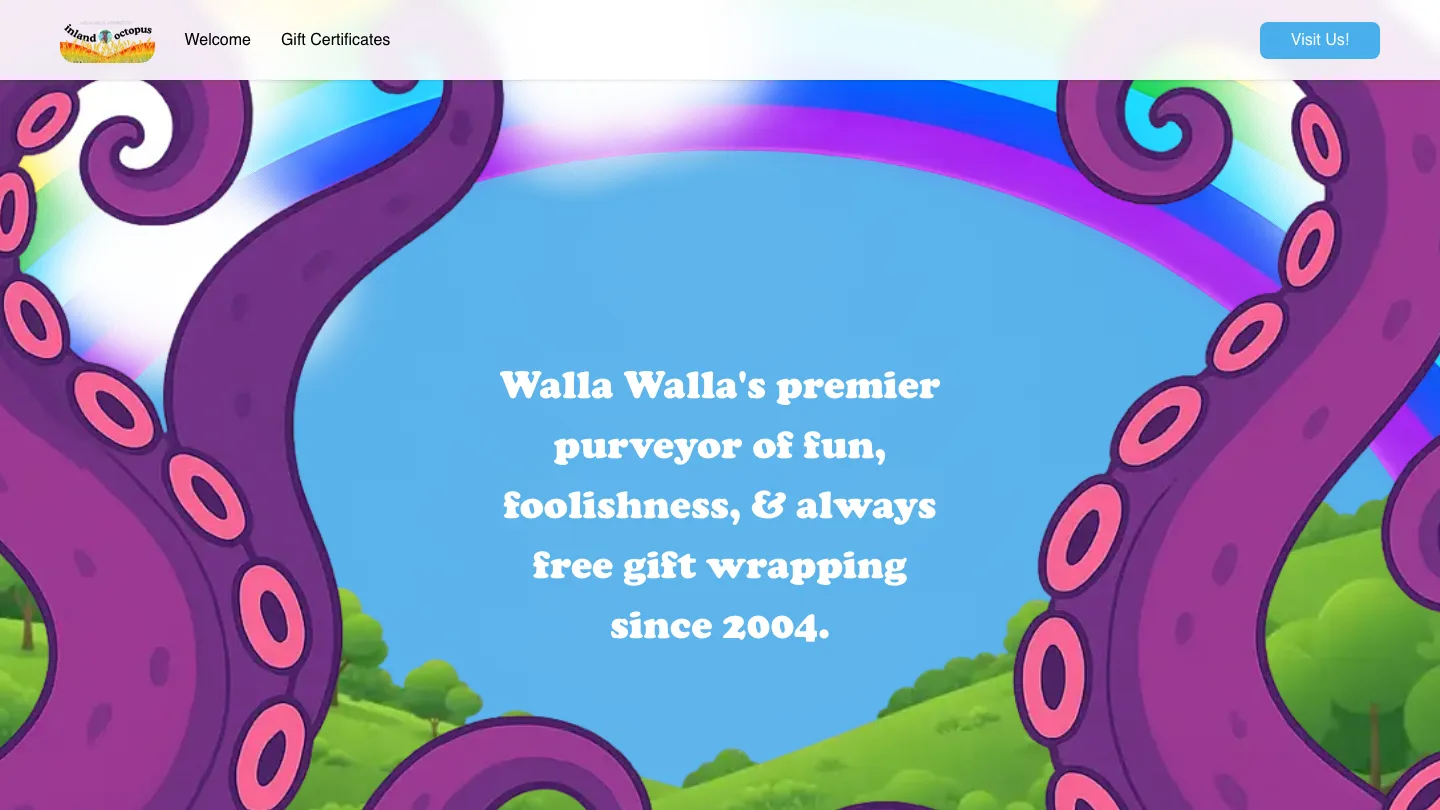
A prototype marketing site for Inland Octopus, a toy and novelty store in Walla Walla, Washington. The site is built around a hand-composed illustrated scene with procedurally generated clouds, and everything is hand-built in Next.js with no template or UI library.
Overview
The home page is a scene: hills, a rainbow, the store front, and drifting clouds, with the store's product categories presented as cards. A second page covers gift certificates. The navbar links between the two pages and out to the store's Instagram and Facebook.
What I built
- An illustrated hero scene. The home page places illustrated layers (rainbow, hills, store front, category cards, decorative lines, a badge) with absolute positioning and animates them with
framer-motion. Most of the work was art direction: tuning positions and sizes until the composition held together, such as stretching the hills and rainbow to fill the screen width. - Procedural clouds. Instead of drawing cloud images, a
ProceduralCloudcomponent draws each cloud on a<canvas>. A seeded random number generator makes every cloud look different while staying the same across renders and rebuilds. Particles are placed with a Gaussian distribution (Box–Muller), so they cluster in the middle and thin out at the edges, which is what makes the shape look like a cloud and not a pile of circles. Props control size, colour, seed and "fluffiness." Because the output is deterministic and drawing is expensive, each cloud renders once and is memoised. - Hover interactions. Category cards tilt slightly on hover, and the badge spins only while you hover over it.
- An embedded map showing the store's location.
- A gift certificates page.
- A separate mobile design for both pages and the navbar, instead of letting the desktop layout collapse.
Design
Canvas clouds scale without pixelation, add nothing to the bundle size, and one component produces many distinct clouds. The pieces that need a hand-drawn look (the rainbow, hills and store front) stay as illustrated images. The tradeoff of composing a scene this way is that responsive behaviour costs more effort, which is why mobile got its own layout.
Tech
Next.js 16 (App Router) · React 19 · TypeScript · Tailwind CSS 4 · framer-motion · Canvas 2D · Vercel.
Status
This is a prototype. It is deployed at inland-octopus.vercel.app, not on the store's own domain. Source: github.com/Techo10n/inland-octopus.